

Picking a retirement plan for your nonprofit can feel like a huge, complicated project. But it doesn't have to be. The decision really comes down to a few key things: your budget, the needs of your staff, and your duties as a plan fiduciary. Get it right, and you've created a powerful tool to attract great people and keep the dedicated team that drives your mission.
Starting Your Search For The Right Nonprofit Retirement Plan
For most nonprofit leaders, the first step isn't comparing different plan types. It’s about asking some foundational questions about your organization's goals and what you can realistically manage. Before you get lost in the weeds of 403(b)s and 401(k)s, your leadership team and board need to get on the same page.
Getting this initial alignment right saves so much confusion later. It ensures the plan you choose actually serves both your employees and your mission. This isn't a decision to be rushed; treat this benefit as a strategic investment in the health of your organization.
A well-designed plan is more than just another line item in your budget—it’s a powerful statement about how much you value your team. It directly impacts your ability to compete for talent in a crowded market and shows a real commitment to your employees' long-term well-being.
Key Questions To Start The Conversation
To build a solid foundation, get your key people in a room—the executive director, finance lead, HR manager, and the relevant board committee. Talk through these essential points and write down the answers. This document will become your roadmap for the whole selection process.
What is our primary goal? Are you trying to attract new talent? Improve retention of the staff you already have? Or do you just need to offer a basic benefit to stay competitive? Your answer here will shape every other choice you make.
What is our budget for contributions? This is often the biggest factor. Figure out if the organization can afford to make employer contributions, like a match or a fixed percentage for everyone.
Who are we serving? Take a close look at your employee demographics. A younger team might care about different features than one with many people nearing retirement. You should consider average tenure, salary levels, and turnover rates.
A common mistake I see is when a nonprofit picks a plan just because a peer organization has it. Your nonprofit has a unique mission, budget, and workforce. Your retirement plan needs to reflect that to be truly effective.
Defining Your Organizational Philosophy
Beyond the practical questions, you need to think about your organization's philosophy. For instance, do you want to encourage everyone to participate by using automatic enrollment? Is it important to your culture that employer contributions vest immediately to reward loyalty from day one?
Answering these bigger-picture questions clarifies what really matters to you. If your main concern is retaining a few key senior leaders, a plan designed with higher contribution limits for them might be the priority.
On the other hand, if your goal is to get broad participation across all salary levels, a plan with a generous employer match for the first few percent of employee savings could be a much better fit. This initial strategic thinking is the most critical step. It ensures you choose a retirement plan that truly serves your nonprofit's unique purpose and its people.
Understanding Your Core Retirement Plan Options
When you start digging into retirement plans, you’ll immediately hit an alphabet soup of options: 403(b), 457(b), and 401(a). For a nonprofit leader, these aren't just confusing numbers—they're distinct tools, each built for different types of organizations and goals.
Getting this right from the start is about more than just checking a box. Think of it like a fundraising strategy; you wouldn't use the same approach for a small local arts group as you would for a national foundation. The right retirement plan depends on your nonprofit's DNA—your size, your team, and your budget. Choosing wisely now saves you from administrative headaches later and, most importantly, fulfills the promise you’ve made to your staff.
This decision tree gives you a quick visual for how to line up your budget, staff needs, and fiduciary duties as you weigh your options.
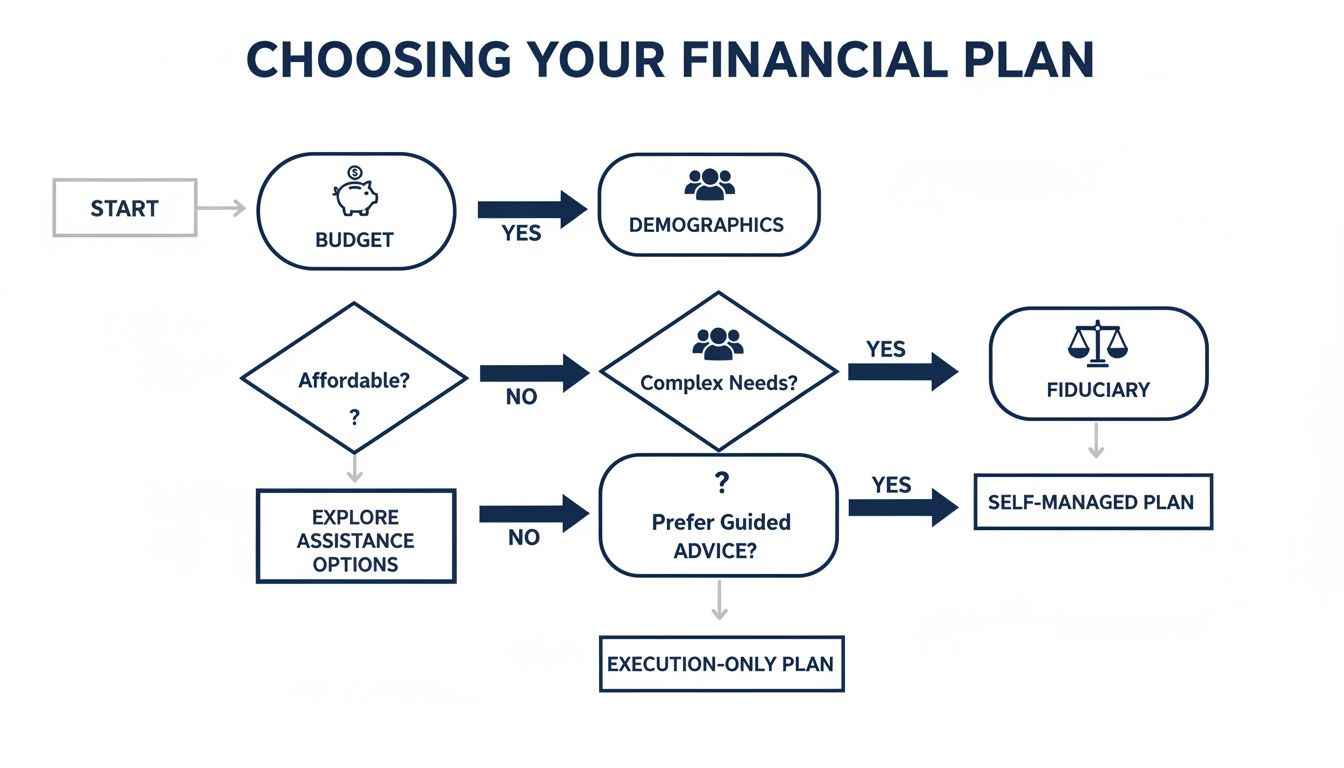
As you can see, a logical, step-by-step approach—starting with what you can afford and then moving to what your team needs—makes the whole process feel much less overwhelming.
The 403(b): The Go-To Plan For Many Nonprofits
The 403(b) plan is the workhorse of the nonprofit retirement world. It's specifically designed for 501(c)(3) organizations like charities, hospitals, schools, and religious institutions. Functionally, it's very similar to the 401(k) plans common in the for-profit sector.
One of its biggest strengths is flexibility. You can set it up to allow both employee deferrals and employer contributions, like a matching program. This structure not only helps employees save for their future but also shows them they're valued.
A key feature many nonprofits now offer is a Roth 403(b) option. This lets employees contribute with after-tax dollars, meaning their qualified withdrawals in retirement are completely tax-free. For younger staff members who are likely in a lower tax bracket today than they will be later, this is a massive advantage.
The 457(b): A Powerful Tool For Key Leaders
While the 403(b) is a great fit for the whole team, the 457(b) plan serves a more specific—and equally critical—purpose. These plans are available to governmental bodies and certain tax-exempt organizations, but for nonprofits, they're most often used as a supplemental retirement benefit for executives and other highly compensated leaders.
What’s the big deal with a 457(b)? One of its most powerful features is that withdrawals are not subject to the 10% early withdrawal penalty that normally hits distributions taken before age 59½. This is a huge benefit for leaders who might plan to retire or transition out of the organization before that age.
For a nonprofit struggling to match for-profit salaries for top talent, a well-structured 457(b) plan can be a game-changing retention tool. It’s a way to offer a meaningful deferred compensation benefit that rewards long-term commitment.
It’s important to know that 457(b) plans for nonprofits are considered "top hat" plans. This means they are unfunded, and the assets technically remain subject to the organization's creditors. This structure demands careful thought and very clear communication with the employees who participate.
The 401(a): The Employer-Focused Plan
Finally, there’s the 401(a) plan, which operates quite differently from the others. A 401(a) is an employer-funded plan. Only the organization contributes; employees cannot make their own salary deferrals. This makes it a great choice for nonprofits that want to provide a guaranteed retirement contribution for their staff, whether employees kick in their own money or not.
These plans are common in government, public schools, and certain nonprofits. They often come with mandatory participation for eligible employees and a vesting schedule, which requires an employee to work for a set number of years to become fully entitled to the employer's contributions.
Nonprofit Retirement Plan Comparison At A Glance
To help you see the differences side-by-side, here’s a quick comparison of the most common retirement plans available to nonprofits. This breakdown of key features can help you quickly assess which one might be the best fit for your organization's goals.
403(b) Plan
Who Can Participate? Employees of 501(c)(3) organizations, schools, and hospitals.
Who Contributes? Employee and/or Employer.
Employee Contributions? Yes.
Early Withdrawal Penalty? Yes (10% before age 59½).
Best For… Broad-based retirement benefits for all staff.
457(b) Plan
Who Can Participate? Typically executives and highly compensated employees; government employees.
Who Contributes? Employee and/or Employer (often as deferred compensation).
Employee Contributions? Yes.
Early Withdrawal Penalty? No.
Best For… Retaining key executives and senior leadership.
401(a) Plan
Who Can Participate? Eligible employees as defined by the plan.
Who Contributes? Employer only.
Employee Contributions? No.
Early Withdrawal Penalty? Yes (10% before age 59½).
Best For… Providing a guaranteed employer contribution.
Choosing the right structure is the first step, but it’s a critical one that sets the stage for a successful, sustainable retirement program for your team.
The scale of this decision is massive. As of mid-2025, total U.S. retirement assets hit $45.8 trillion. Defined contribution (DC) plans like the 403(b) now hold $13.0 trillion of that and are growing at over 6% each quarter. This shift away from complex pension plans shows why focusing on simpler DC options is smart for nonprofits looking to reduce administrative weight and fiduciary risk. If you're weighing these options, you might also find value in our guide on the role of 401(k)s for nonprofits.
Meeting Your Fiduciary Duties as a Nonprofit Leader
When you’re a nonprofit leader or board member, choosing a retirement plan isn't just about offering another benefit. It’s a role that comes with serious legal weight—you’re acting as a fiduciary. That’s a formal term for a position of trust, and it means you have a legal and ethical duty to act solely in the best interests of your employees and their families.
This isn’t just a friendly suggestion; it’s a legal mandate, often governed by dense regulations like the Employee Retirement Income Security Act (ERISA). Getting a handle on these responsibilities is the first step toward building a retirement program that’s not only competitive but also compliant and trustworthy.

Get this wrong, and you could expose your organization to significant liabilities—and that can even include personal liability for board members. The good news is that with a clear, documented process, you can navigate these duties confidently and protect both your employees and your mission.
Embracing The Prudent Person Rule
At the very core of your fiduciary duty is the "prudent person rule." It’s a standard that requires you to act with the care, skill, and diligence that a knowledgeable person would use in a similar situation. Put simply, you can't just wing it.
Think about how you manage your nonprofit's finances. You wouldn't approve a major budget line item without research, documentation, and a solid rationale. The exact same level of diligence is expected when you're choosing and overseeing a retirement plan.
Here’s how to put that into practice:
Establish a formal process: Create a clear, repeatable system for evaluating plan options and service providers.
Document everything: Keep detailed minutes from every meeting where the retirement plan is on the agenda. Note the options you considered, the data you reviewed, and the logic behind your final decisions.
Bring in experts when needed: You aren't expected to be a retirement plan expert. Fulfilling your duty often means hiring qualified, independent consultants to guide you through the complexities.
This structured approach is your best defense. It proves you took the role seriously and made decisions based on a thoughtful and deliberate process.
The Importance Of Monitoring Plan Fees
A huge piece of your fiduciary duty is making sure all plan-related fees are reasonable. Excessive fees can gut your employees' retirement savings over time, and it's an issue regulators watch like a hawk. In fact, sky-high fees are one of the most common reasons plan sponsors get sued.
You need to understand every single cost tied to the plan—administrative fees, recordkeeping charges, and other service expenses, you name it. And this isn't a one-and-done task. You have an ongoing responsibility to monitor these fees to ensure they stay fair and competitive year after year.
Your duty is to ensure the fees are reasonable for the services provided. This doesn't mean you must always choose the absolute cheapest option, but it does mean you need a documented reason for why the services you selected justify their cost.
Choosing the right retirement plan can even be benchmarked against global standards. For instance, the Mercer CFA Institute Global Pension Index 2025 evaluates systems on integrity, adequacy, and sustainability, with top performers like the Netherlands and Singapore setting a high bar. For U.S. nonprofits, where defined contribution (DC) plans now hold $13.0 trillion in assets, this underscores the need to prioritize designs that emphasize transparency and good governance. This global perspective reinforces that a core fiduciary duty is building a plan that is not just compliant but also sustainable for the long term. You can explore the full findings on global pension integrity to learn more.
Creating a Retirement Plan Committee
One of the best ways to manage your fiduciary duties is to form a dedicated retirement plan committee. This group, usually made up of a few board members and key staff, can be formally tasked with overseeing the plan.
This committee takes the lead on:
Developing a Plan Governance Document: This is a formal road map that outlines the process for selecting and monitoring the plan’s service providers.
Conducting Regular Reviews: The committee should meet at least annually—preferably more—to review plan performance, fees, and provider services.
Keeping Meticulous Records: All committee meetings, discussions, and decisions have to be thoroughly documented.
Delegating oversight to a committee doesn't erase the board's ultimate fiduciary responsibility, but it creates a structured and effective framework for managing it. This approach ensures the plan gets the focused attention it deserves. For a deeper dive, we have more resources on navigating your fiduciary responsibility.
Ultimately, fulfilling your duties comes down to process and diligence. Get that right, and you can confidently offer a benefit that truly supports the people driving your mission.
Evaluating Vendors And Analyzing Plan Costs
Choosing the right service provider is just as important as picking the right type of plan. Once you’ve landed on a plan design that fits your nonprofit’s mission and team, the next step is finding a partner who can bring that vision to life. This isn't just an administrative task; it's a core fiduciary responsibility that directly impacts your employees' retirement outcomes.
The vendor you select—whether a recordkeeper or a third-party administrator (TPA)—will manage the day-to-day operations of the plan. A great partner makes everything feel seamless and valuable. A poor one creates frustration and piles on administrative burdens. Your goal is to find a vendor with proven experience in the nonprofit world who truly gets the unique challenges and compliance needs you face. Or work with your Consultant to help gather this information to review timely.
Creating Your Vendor Shortlist
Before you start sending out formal Requests for Proposals (RFPs), it’s smart to build a shortlist of potential vendors. Look for providers who specialize in the nonprofit space and the specific plan you’re leaning toward, whether it’s a 403(b), 457(b), or 401(a).
You can build this list by:
Asking for peer recommendations: Talk to other nonprofit leaders in your network. Who do they use? What has their experience been like?
Consulting with an consultant and/or independent advisor: A retirement plan consultant can give you a curated list of vendors who are a good match for your specific needs and budget.
Doing your own research: Look for providers who prominently feature their work with 501(c)(3) organizations on their websites and in case studies.
Once you have three to five strong candidates, you're ready to dig deeper.
Key Questions To Ask Potential Vendors
Your RFP process is where you conduct your due diligence. It’s your chance to look past the sales pitch and understand how a vendor really operates. A well-structured set of questions will help you compare providers on an apples-to-apples basis.
Make sure to focus your questions on these core areas:
Experience with Nonprofits: Ask for references from other nonprofit clients of a similar size and complexity. How many 403(b) or 457(b) plans do they actually administer?
Service Model: Who will be your dedicated point of contact? What are their service-level agreements for responding to questions from your team and your employees?
Technological Capabilities: Ask for a demo of their online portal for both administrators and participants. Is it user-friendly, intuitive, and secure?
Fiduciary Support: What specific services do they offer to help your board and retirement committee meet their fiduciary obligations?
A vendor's response to your questions about fiduciary support is incredibly telling. A true partner will be eager to explain how they help you maintain compliance and document a prudent process, rather than brushing the topic aside.
Demystifying The Layers Of Plan Fees
Perhaps the most critical part of your evaluation is a thorough analysis of plan costs. High fees can seriously erode your employees' savings over time, and as a fiduciary, you have a duty to ensure every cost is reasonable for the services provided.
Plan fees are often complex and can be broken down into several layers. You need to identify and compare every single one.
Administrative and Recordkeeping Fees: These are the costs for the day-to-day management of the plan, like processing contributions and preparing statements. They can be structured as a flat per-participant fee or as a percentage of plan assets.
Investment Fees: These are expenses from the financial institution that offers the investments.
Other Service Fees: This catch-all can include costs for services like participant education, loan administration, or processing distributions.
It is absolutely essential to get a full, transparent breakdown of all potential fees in writing from each vendor. Don't be afraid to ask for clarification if anything is unclear. For more strategies, many nonprofits have found success using specific techniques for how to reduce retirement plan administration costs without sacrificing quality. This thorough cost analysis is a cornerstone of your fiduciary duty.
Implementing Your New Plan and Engaging Your Team
You’ve navigated the options, analyzed the costs, and finally selected a vendor. That’s a huge milestone, but now the real work begins. A retirement plan is only successful if it moves from a documented decision to a living, breathing benefit that genuinely supports your team.
The launch process involves a lot of practical steps, from finalizing the legal plan document to getting the first deductions right with your payroll provider. A smooth rollout is critical—it sets a positive tone and ensures your employees’ first experience with their new benefit is a good one. After all, a plan is only as strong as its participation rate.

Launching The Plan Smoothly
A successful implementation really comes down to good project management. The first thing you should do is create a detailed timeline with clear responsibilities for both your internal team and your new vendor. This roadmap makes sure everyone knows what needs to happen and when, preventing critical details from slipping through the cracks.
Your launch checklist should cover a few non-negotiables:
Finalizing the Plan Document: This is the legally binding document that governs your plan. Review it meticulously with your vendor and legal counsel to ensure it perfectly reflects every design feature you decided on.
Integrating with Payroll: Work hand-in-hand with your payroll administrator to set up the new deduction codes. It's a great idea to test the system before the first live payroll run.
Establishing Fiduciary Processes: If you haven’t already, formally establish your retirement plan committee and adopt a plan governance document. This is a crucial step in fulfilling your ongoing oversight duties.
Getting these technical pieces right from the start saves you from administrative headaches down the line and builds immediate trust in the new program.
Crafting An Effective Education Campaign
Let’s be honest—a new retirement plan can feel intimidating to employees. Your job is to cut through the jargon and give them simple, compelling reasons to participate. A strong education campaign is the bridge between offering a plan and having your team actually use it to build their financial future.
This can't be just one email with an enrollment link. A multi-channel approach always works best. Think about hosting small-group sessions, offering one-on-one meetings, and providing easy-to-read digital resources. The goal is to meet your employees where they are and answer their questions in a supportive environment.
The most successful campaigns I've seen focus on the "why" before the "how." Instead of leading with contribution limits, they start by helping employees visualize their future and showing how small, consistent savings can make that future a reality.
Today’s economic climate makes this education more critical than ever. Recent global retirement surveys show that 33% of U.S. participants are delaying retirement due to market volatility. Strong plan design and clear communication can help mitigate that anxiety. When employees understand their options and feel confident, they are more likely to stay the course. You can explore a deeper dive into these global retirement realities and insights to better inform your strategy.
Encouraging High Participation From The Start
Ultimately, your goal is high participation. Strong engagement doesn’t just help your employees; it reinforces the value of the benefit your organization is providing. It shows a shared commitment to your team's long-term well-being, which is a powerful driver of morale and loyalty.
Consider a few powerful tools to boost enrollment right away:
Automatic Enrollment: This is easily one of the most effective ways to increase participation. Employees are automatically enrolled unless they actively opt out, turning inertia into a positive force. It can lift participation rates by 40-60%.
A Clear and Compelling Match: If you offer an employer match, make the formula dead simple to understand. Frame it as "free money" they are leaving on the table if they don't contribute enough to get the full match.
Ongoing Communication: Engagement doesn't stop after the launch. Plan for regular check-ins, workshops, and communications throughout the year to keep the benefit top-of-mind and encourage employees to increase their savings over time.
For many nonprofits, navigating these implementation steps while building an engagement plan can feel overwhelming. This is where specialized nonprofit retirement plan consulting services can provide invaluable support. By putting as much care into the rollout as you did into the selection, you create a retirement program that truly strengthens your mission by securing the future of the people who make it possible.
Common Questions About Nonprofit Retirement Plans
Even after you've gone through a thoughtful selection process, a few key questions almost always come up. It's natural for nonprofit leaders to wrestle with the same handful of concerns as they finalize a new retirement plan or think about managing it for the long haul.
Getting these answers straight is what allows you to move forward with confidence. You’ll know exactly how to handle vendor agreements, what your day-to-day duties look like, and when it’s time to take a fresh look at your program.
What Are My Ongoing Responsibilities After The Plan Is Live?
Launching the plan feels like crossing the finish line, but in reality, your fiduciary duties are just getting started. Once the plan is up and running, your primary role shifts from selection to diligent oversight. This isn't a one-time task—it's a continuous cycle of monitoring, documenting, and making sure the plan serves the best interests of your employees.
This ongoing governance boils down to a few key activities:
Hold Regular Committee Meetings: Your retirement plan committee needs to meet at least once a year, though quarterly is even better. Use this time to review the plan's performance, check in on your service provider, and make sure the fees are still reasonable.
Document Everything: I can't stress this enough. Keep detailed minutes of every single committee meeting. These records are your best defense, proving you have a prudent process for overseeing the plan and making informed decisions.
Ensure Timely Contributions: This is non-negotiable. You must deposit employee deferrals and any employer contributions into the plan on time, every single payroll cycle. Even small delays can trigger significant compliance penalties.
Your fiduciary role doesn't end when the vendor contract is signed. In fact, that's when the most important phase begins. Consistent oversight is the foundation of a well-managed, compliant, and effective retirement program that truly serves your team.
This disciplined process is the best way to manage risk and show your team you're committed to their financial well-being.
How Do I Handle A Vendor Contract?
That service agreement from your vendor is a serious legal document. It lays out the scope of services, all the fees, and the responsibilities for both you and them. Before you sign anything, review every single detail—ideally with an advisor or legal counsel who lives and breathes this stuff.
Pay special attention to the termination clause. You need to understand exactly what it would take to change providers down the road, including any potential costs. A fair and flexible contract protects your organization from getting stuck in a partnership that no longer works. Your vendor should be a partner, not a roadblock.
When Should We Review Or Change Our Current Plan?
Deciding how to choose a retirement plan is a huge project, but it's not a decision you make once and forget about. The perfect plan from five years ago might not fit your organization’s goals or your team's needs today. As a rule of thumb, it’s smart to conduct a formal review of your plan design every three to five years.
Of course, certain events might trigger an earlier review:
Major Shifts in Your Workforce: If your team's demographics have changed—maybe the average age is much younger or older—your plan design might be out of sync.
Organizational Growth or Budget Changes: Has your nonprofit grown a lot? Or has your financial picture changed? You might be in a position to offer a more generous contribution or add new features.
Consistently High Fees: If a fee benchmarking report shows your plan's costs are way above average for a plan your size, it is absolutely time to see what else is out there.
Poor Service from Your Current Vendor: Persistent administrative mistakes, a vendor who never calls you back, or terrible support for your employees are all perfectly valid reasons to start looking for a new provider.
Regularly reviewing your plan ensures it remains a competitive and meaningful benefit. For more answers to specific questions, you can also check out these nonprofit retirement plan frequently asked questions for additional clarity.
At NPDiva Consulting, we specialize in helping nonprofits navigate these questions with clarity and confidence. We provide expert guidance tailored to your mission, ensuring your retirement plan strengthens your team and supports your long-term goals. https://npdiva.com