

If you’re a nonprofit leader, you’ve probably heard the term “maximum annual benefit” before. It’s one of those crucial concepts that underpins compliant and attractive retirement plans. Think of it as a government-set annual cap on the contributions and benefits that can be put into a tax-advantaged retirement program.
The whole point is to keep things fair across the board for all employees. Honestly, getting these rules right is a cornerstone of your fiduciary duty.
Unpacking The Maximum Annual Benefit For Nonprofits

The idea of a maximum annual benefit, which comes from IRS Section 415, is a fundamental safeguard in the world of retirement planning. Its primary mission is to prevent tax-advantaged plans from becoming a lopsided perk that mainly benefits an organization's highest earners.
By putting these limits in place, the IRS pushes for equitable savings opportunities for everyone, from your frontline staff all the way up to executive leadership.
For a nonprofit, staying inside these lines isn't just about compliance. It’s a powerful way to demonstrate responsible stewardship of your resources and prove your commitment to the financial well-being of every single person on your team.
How The Limits Apply To Different Plan Types
The rules for the maximum annual benefit are definitely not one-size-fits-all. They work differently depending on the kind of retirement plan your nonprofit offers, a distinction that’s vital for both proper administration and smart plan design.
There are two main buckets to think about:
Defined Benefit (Pension) Plans: In these more traditional pension plans, the limit applies to the total annual payout an employee can actually receive in retirement. It keeps that promised future income stream from going over a specific boundary.
Defined Contribution Plans (e.g., 403(b), 401(a)): For the plans most nonprofits use today, the limit applies to the total annual additions—all the money from all sources—that go into a participant's account in a single year. This includes both employee deferrals and any employer contributions.
Just knowing which limit applies to your specific plan is the first, most important step. As you get deeper into the details, you can explore our other resources on nonprofit retirement plans to see how different structures align with your mission.
Why This Matters For Your Organization
Getting a handle on these rules is so much more than a technical chore for your finance or HR team. It directly impacts your ability to design a retirement benefit that is both competitive enough to attract great people and sustainable enough for your budget. A well-built plan helps you find and keep the dedicated talent you need to move your mission forward.
For nonprofit boards and fiduciaries, overseeing compliance with IRS Section 415 limits is a core component of their governance role. Failing to monitor these caps can lead to significant penalties, corrective actions, and even plan disqualification, jeopardizing the retirement security of all employees.
At the end of the day, mastering the maximum annual benefit gives you the power to build a retirement program that rewards your team fairly, supports their long-term financial security, and aligns perfectly with your organization's values.
The Guardrails on Defined Benefit Pension Payouts
Defined benefit pension plans, while less common these days, are still one of the most powerful tools a nonprofit can use to attract and keep top-tier leadership. These plans are so valuable because they promise a specific, guaranteed income for life in retirement—a level of security that’s hard to find anywhere else. But with that power comes serious responsibility, and the IRS has strict rules to make sure these tax-advantaged plans are used fairly.
The maximum annual benefit isn’t just one flat number. Think of it like a highway with two guardrails. Your plan’s annual payout has to stay between them. It can’t exceed the lower of two separate limits, which keeps the benefit firmly within a federally approved lane.
The Two-Part Rule That Governs Pension Payouts
The IRS sets a firm ceiling on what these plans can pay out each year. A retiree’s annual pension is capped by whichever of two key figures is lower. This dual-limit approach ensures the benefit makes sense in relation to the employee’s actual career earnings while also sticking to a universal maximum that applies to everyone.
Here are the two parts of the rule:
The Compensation Limit: The annual pension can’t be more than 100% of the participant’s average compensation during their three highest-paid consecutive years.
The Dollar Limit: The annual pension also can’t exceed a specific dollar amount set by the IRS, which gets adjusted each year for inflation.
This structure prevents a scenario where a very highly compensated executive could receive a pension that, while technically under their salary, is completely out of proportion with national standards.
A Closer Look at the IRS Dollar Limit
That dollar limit is a moving target, and for good reason—it’s designed to keep up with the cost of living. For the current year, the IRS sets this limit at the lesser of 100% of a participant's average pay over their highest three consecutive years or a specific dollar amount. This dollar figure is adjusted annually, ensuring the plan’s value doesn’t get eroded by inflation over time. You can find the nitty-gritty details on how the IRS handles these adjustments on their official page for defined benefit plan limits.
This annual adjustment is a critical feature. It means the maximum annual benefit grows over time, maintaining its real-world value for employees who might be decades away from retirement.
How Actuarial Math Makes It All Work
Behind every guaranteed pension check is a mountain of complex actuarial math. These calculations are the engine that powers the whole plan, making sure enough money is being set aside today to deliver on promises made for tomorrow.
An actuary’s core job in a defined benefit plan is to translate a future promise into a present-day funding requirement. They juggle dozens of variables to figure out exactly how much your nonprofit needs to contribute each year, ensuring the plan stays solvent and can meet its obligations to every single participant.
This process hinges on a few key assumptions:
Participant Life Expectancy: Actuaries use mortality tables to estimate how long retirees are likely to live, which tells them how many years of payments the plan needs to be prepared to make.
Retirement Age: The calculation also depends on when a participant is expected to retire. Retiring earlier or later can dramatically change the funding timeline and the total cost.
These factors help determine the total lump sum of money needed at the moment of retirement to fund that promised stream of lifetime payments. This is what makes a defined benefit plan such a potent—though complex—tool for rewarding key nonprofit leaders. It offers a promise of security that is increasingly rare, helping you recognize and reward true long-term commitment.
Navigating Contribution Limits In 403(b) And Similar Plans
For most nonprofits, the retirement plan conversation isn't about pensions with a guaranteed payout at the end. It's about defined contribution plans like the ever-popular 403(b). With these plans, the focus shifts from limiting the final benefit to capping what can be put in each year.
Think of it like a bucket. Each year, every participant has their own retirement bucket, and IRS rules say you can only fill it so high. This overall limit is called the maximum annual benefit, and it’s defined by the total annual additions that go into an employee’s account from all sources. Every dollar—whether it comes from the employee or the organization—counts toward filling that bucket.
The Three Core Components of Annual Additions
So, what exactly fills up this annual bucket? The IRS looks at three specific types of contributions. Each one helps an employee save for retirement, but when you add them all together, they absolutely cannot go over that annual cap.
Let’s look at the three streams that combine to hit the limit.
Employee Elective Deferrals: This is the money an employee decides to save directly from their paycheck, usually on a pre-tax basis. It’s the foundation of their personal savings effort.
All Employer Contributions: This is a big one. It includes every dollar your nonprofit puts in for the employee, from matching contributions you make to reward saving, to non-elective contributions you might make for everyone regardless of what they put in.
Plan Forfeitures: What happens when an employee leaves before they are fully vested in the employer’s contributions? That unvested money is forfeited. If your plan reallocates those forfeited funds to the accounts of the remaining employees, that money also counts as an annual addition.
Keeping a close eye on all three streams is a core fiduciary duty. If the total goes over the limit, even by accident, you’re looking at a compliance headache that needs to be fixed. For a deeper dive into how these plans stack up against other options, check out our guide on 403(b) plans vs. 401(k) plans.
The flowchart below shows how pension plans cap the payout, which is a totally different ballgame than the contribution-based limits we're talking about for 403(b)s.
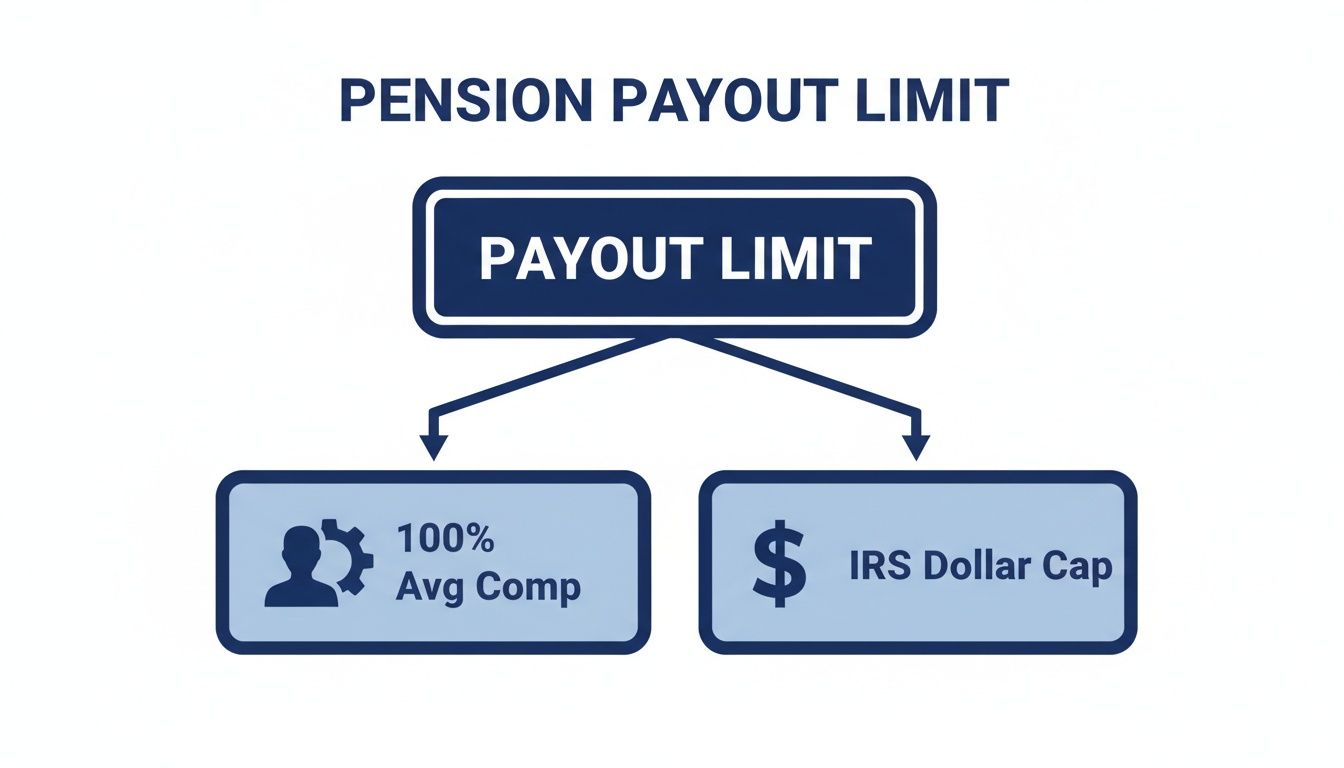
As you can see, pensions have two guardrails—compensation and a dollar cap. A 403(b), on the other hand, just has that single, cumulative bucket for contributions.
Now, let's explore how all these pieces come together in a typical nonprofit plan.
Components Of The Defined Contribution Annual Limit
Here are the different types of contributions that add up to the overall maximum annual limit in a typical nonprofit defined contribution plan.
Employee Elective Deferrals: These are pre-tax or Roth contributions from an employee's paycheck, made by the employee. They count towards the overall limit.
Employer Match: These are contributions the employer makes to match a portion of employee deferrals. They are made by the employer and count towards the overall limit.
Employer Non-Elective: These are contributions the employer makes for all eligible employees, regardless of whether they contribute. They are made by the employer and count towards the overall limit.
Reallocated Forfeitures: This is unvested employer funds from terminated employees that are reallocated to current employees. This is considered an employer contribution and counts towards the overall limit.
Age 50+ Catch-Up: These are extra contributions allowed for employees aged 50 and over. They are made by the employee but do not count towards the overall annual limit, as they have a separate limit.
15-Year Service Catch-Up: This is a special catch-up for certain long-tenured employees in 403(b) plans. They are made by the employee but do not count towards the overall annual limit, as they have a separate limit.
Understanding this breakdown is key to designing a plan that maximizes benefits without accidentally triggering compliance issues. It's a balancing act, but one that's crucial for every plan sponsor.
Unique Catch-Up Contributions In 403(b) Plans
One of the best features of 403(b) plans is the powerful set of catch-up contribution rules. These are designed to help long-serving or older employees really ramp up their savings as they get closer to retirement, making up for years when they might not have saved as much.
Crucially, these catch-up amounts are allowed on top of the regular employee contribution limit.
Key Insight: Don't think of catch-up contributions as a minor perk. They are a strategic tool for retaining your most experienced, dedicated staff. For employees who have poured their careers into your mission, these provisions can make a world of difference in their retirement readiness.
There are two main types of catch-up contributions you need to know about:
Age 50+ Catch-Up: This is the most familiar one. Any participant who is age 50 or over can contribute an additional amount above the standard employee limit.
15-Year Service Catch-Up: This is a special rule unique to certain 403(b) plans. An employee who has put in at least 15 years of service with your organization might be eligible to contribute an additional amount, though it's subject to a lifetime cap.
Administering these provisions correctly is critical. While the catch-up amounts themselves don’t count toward the overall annual additions limit, all the moving parts have to be tracked perfectly to keep the plan compliant. The limits are also adjusted by the IRS almost every year, so staying on top of the latest numbers is a must.
By understanding how regular contributions, employer money, and these special catch-up rules all fit together, you can design a retirement plan that not only stays compliant but truly rewards the people who make your organization’s work possible.
How 457 Plans Can Supplement Executive Retirement Benefits
When nonprofits design a competitive benefits package for leadership, the conversation often starts—and stops—with the standard 403(b) plan. But to truly compete for top talent, organizations need more tools in their toolkit.
This is where 457 plans come into play. They are powerful, specialized plans that can supplement executive retirement savings, and they operate with a unique set of rules that sets them apart from anything else you offer.
Think of it this way: your 403(b) plan is the main highway for retirement savings, with its own traffic rules and speed limits set by Section 415. A 457 plan is like opening a private, parallel lane just for your key leaders, with its own set of regulations.
The Power Of Separate Deferral Limits
The single biggest advantage of an eligible 457(b) plan is that its contribution limits are completely separate from those of a 403(b) or 401(a) plan. This is a game-changer for executive compensation strategy.
It means a key employee can contribute the absolute maximum to their 403(b) and also contribute the maximum to their 457(b) in the same year. This dual-contribution approach lets leaders effectively double their personal savings capacity, moving far beyond what a single plan could ever offer.
This directly addresses a common frustration where the standard maximum annual benefit limits in a 403(b) just aren't enough for higher earners to adequately prepare for retirement.
By offering both a 403(b) and a 457(b), a nonprofit creates a highly attractive and competitive retirement benefits package. It’s a critical strategy for recruiting and retaining top executive talent who might otherwise be drawn to the for-profit sector.
This is a fully compliant approach that provides a structured way to reward and retain the people most critical to your mission. For a more detailed look, you can learn more about how 457(b) plans for nonprofits can be structured.
A Tale Of Two Plans: 457(b) Vs. 457(f)
It’s important to know that not all 457 plans are created equal. Nonprofits can use two main types, and they serve very different purposes. Getting this distinction right is crucial for smart plan design.
Here’s a simple breakdown:
Eligible 457(b) Plans: These are the plans with their own annual contribution limits, totally separate from 403(b) limits. They offer a straightforward way for executives to save more tax-deferred money each year.
Ineligible 457(f) Plans: Often called "Top Hat" plans, these are non-qualified deferred compensation arrangements. They have no annual contribution limit, allowing an organization to promise a future benefit of any size. The catch? The funds are subject to a substantial risk of forfeiture until a specific event occurs, like retirement.
While a 457(b) is about maximizing an executive's current savings, a 457(f) is a powerful retention tool. It can be used to create "golden handcuffs" that incentivize a key leader to stay with the organization long-term to receive their deferred compensation.
Putting It All Together: A CEO Scenario
Let's walk through a realistic example to see how this works in practice.
Imagine your nonprofit’s CEO wants to maximize her retirement savings. She is already contributing the maximum allowed to her 403(b) account, including her age 50+ catch-up contributions. But she still feels she isn't saving enough.
By implementing a 457(b) plan, your organization gives her another avenue. She can now contribute an additional amount—up to the separate 457(b) limit—on top of what she’s already saving in the 403(b).
This combination significantly boosts her total retirement nest egg and makes her compensation package far more competitive. The organization could even layer on a 457(f) plan to promise a supplemental benefit after she completes ten more years of service, solidifying her long-term commitment.
This strategic layering of plans shows a deep commitment to your leadership, all while working within established regulatory frameworks. It turns a standard benefit offering into a powerful strategic asset.
Meeting Your Fiduciary Duties Through Plan Compliance
Knowing the rules around the maximum annual benefit is one thing. Proving your plan actually operates within those legal boundaries is where the real work begins for a nonprofit fiduciary. This is where annual testing and diligent compliance become mission-critical—it’s how you demonstrate your commitment to the organization and its employees.
Think of it as a required annual health checkup for your retirement plan. These tests aren't optional; they're a fundamental part of being a plan sponsor. They ensure the benefits you provide are distributed fairly and don't end up disproportionately favoring your most highly compensated employees.
Ensuring Fairness Through Nondiscrimination Testing
A huge piece of your annual compliance routine involves nondiscrimination testing. These tests go hand-in-hand with monitoring the maximum annual benefit limits. While the 415 limits put a hard ceiling on contributions for everyone, nondiscrimination rules look at the relative benefits different employee groups are receiving.
The goal is to make sure your plan doesn't become a top-heavy vehicle that primarily benefits executives at the expense of everyone else. Your Third-Party Administrator (TPA) runs a series of complex calculations comparing the savings rates of highly compensated employees (HCEs) against non-highly compensated employees (NHCEs). A passing grade is proof that your plan works equitably for all staff. For a deeper dive into these duties, you can learn more about exercising your fiduciary responsibility and acting in the best interest of every participant.
The High Cost Of Exceeding Annual Limits
Accidentally exceeding the maximum annual benefit, even by a small amount, can snowball into a massive headache. The IRS takes these limits very seriously, and the fallout from an overage can be expensive and damaging to your nonprofit’s reputation.
An excess contribution isn't just a simple accounting error. It's a compliance failure that signals a breakdown in plan oversight. Prompt and precise correction is the only way to protect the plan's tax-qualified status and uphold your fiduciary duty.
Failing to correct an overage in a timely manner can trigger a cascade of negative outcomes. We’re not talking about minor slaps on the wrist; these consequences can threaten the very existence of your retirement plan.
Potential consequences include:
Corrective Distributions: The excess amount, plus any earnings it generated, must be returned to the participant or employer. That distribution is usually taxable income for the recipient in the year it's paid out.
Excise Taxes: A 10% excise tax is often slapped on the employer for making nondeductible, excess contributions. This is a direct penalty for the compliance failure.
Plan Disqualification: In the most severe cases of uncorrected or repeated violations, the IRS can disqualify your entire retirement plan. This is a catastrophic outcome that would make all plan assets immediately taxable to all participants, erasing the very benefits you worked so hard to provide.
Compliance As A Core Fiduciary Function
It’s a mistake to view compliance as just another administrative chore. You need to reframe it as a fundamental part of your board’s duty to act prudently and in the best interests of every single plan participant. Meticulous record-keeping is your best defense against compliance failures.
This is why your relationship with a knowledgeable TPA is so critical. They are your experts on the ground, running the complex tests, monitoring contribution levels, and flagging potential issues before they escalate into serious problems. That partnership is how you demonstrate prudent governance and safeguard the financial future you've promised your dedicated team.
Strategic Plan Design To Advance Your Mission

This is where the rubber meets the road—translating complex regulations into real-world action. Your retirement plan stops being just a line item and becomes a strategic asset for your mission. When you understand the rules around the maximum annual benefit, you can thoughtfully build a program that attracts, retains, and rewards the people who make your vision a reality.
This isn’t just about staying compliant. It’s about crafting a sustainable and competitive benefits package that sends a powerful message about how much you value your team. A well-designed plan respects your budget, stays within IRS limits, and boosts employee participation, ultimately strengthening your organization for the long haul.
Structuring Employer Contributions For Maximum Impact
How you contribute to your employees' retirement accounts says a lot about your commitment to their financial well-being. Two common approaches offer different strategic advantages, but both must operate within the overall annual additions limit.
Choosing your contribution formula is a critical step in aligning your plan with both your budget and your employee engagement goals.
Matching Contributions: This popular method incentivizes employees to save by matching a portion of their own contributions. For example, you might match 50% of what an employee puts in, up to 6% of their salary. It's a great way to encourage active participation and reward those who prioritize saving for their future.
Non-Elective Contributions: With this formula, your nonprofit contributes a set percentage of every eligible employee's salary, whether they contribute or not. This is often used in "safe harbor" plan designs to automatically pass nondiscrimination testing. It also ensures every single team member receives a benefit, reflecting a powerful commitment to universal financial support.
Each path has its merits. A matching formula can stretch a limited budget further and drive engagement, while a non-elective contribution ensures everyone benefits—a powerful cultural statement.
Adding Flexibility With Roth Deferrals
A modern retirement plan should meet employees where they are financially. Adding a Roth deferral option to your 403(b) or similar plan is a fantastic, no-cost way to provide valuable tax diversification for your team.
Unlike traditional pre-tax contributions, Roth deferrals are made with post-tax dollars. This means employees don’t get an immediate tax deduction, but their qualified withdrawals in retirement are completely tax-free.
Offering a Roth option empowers your staff to make financial decisions that best suit their long-term outlook. For younger employees who expect to be in a higher tax bracket later in life, or for anyone who values the idea of tax-free income in retirement, this feature is a significant and highly valued perk.
This flexibility allows employees to choose the tax treatment that aligns with their personal situation, making your benefits package that much more valuable.
When To Review Your Plan and Engage a Consultant or Advisor
A retirement plan is not a "set it and forget it" benefit. Your organization's needs evolve, your team changes, and the regulatory landscape is always shifting. A regular, proactive plan review is a fundamental part of your fiduciary duty.
Think of it as a strategic check-in to make sure your plan still aligns with your mission and goals.
You should consider a formal plan review if you experience:
Significant Organizational Growth: A jump in your staff size or budget may allow you to offer more generous contributions or different features.
Changes in Employee Demographics: A younger workforce might value a Roth option more, while an aging team may be more focused on maximizing catch-up contributions.
Recruitment or Retention Challenges: If you're struggling to attract or keep top talent, your retirement plan might not be as competitive as it needs to be.
Major Regulatory Updates: New legislation can create both new compliance hurdles and new opportunities for plan design.
Engaging with an consultant or advisor who specializes in the nonprofit sector is the best next step. A knowledgeable partner can help you assess your current plan, benchmark it against your peers, and model changes to see how they would impact your budget and your team. This collaborative process ensures your retirement plan isn’t just compliant, but a true engine for advancing your mission.
Frequently Asked Questions About Annual Benefit Limits
Retirement plan compliance is full of tricky details, and it's natural for nonprofit leaders to have questions. This section cuts through the jargon to give you direct answers on the maximum annual benefit and how these rules play out in the real world for your organization.
What Happens If An Employee Works For Two Unrelated Nonprofits?
This is a great question and one we see all the time, especially in communities with a vibrant nonprofit sector.
If someone contributes to separate 403(b) plans at two different, unrelated organizations, the limit on their personal elective deferrals follows them as an individual. That means their own contributions across all plans can’t exceed the annual IRS cap.
However, the overall annual additions limit—the one that includes employer money—is applied on a per-employer basis. So, an employee could absolutely receive employer contributions from both nonprofits, as long as each separate plan stays within its own limit.
Do Catch-Up Contributions Count Toward The Limit?
No, they don't—and this is a huge advantage for staff members who are getting closer to retirement.
Both the standard Age 50+ catch-up and the special 15-Year Service catch-up for 403(b) plans operate under their own separate ceilings.
Think of it this way: these contributions are allowed on top of the general limit for annual additions. They're a powerful tool for helping your long-serving, experienced staff give their savings a final boost without running afoul of the primary benefit rules.
How Often Do These Limits Change?
Nearly every year. The IRS typically reviews all the key dollar limits for retirement plans and announces adjustments each fall to reflect cost-of-living changes. This isn't just one number; it includes everything from the defined benefit payout cap to the annual additions limit, plus all the employee deferral and catch-up amounts.
Keeping up with these annual updates is a fundamental fiduciary responsibility. If you have specific questions about how these rules apply to your team, you can always explore our extensive collection of frequently asked questions for nonprofits. It's critical that your finance or HR leaders work with a plan administrator who is on top of these changes to keep your plan compliant and running smoothly.
At NPDiva Consulting, our entire focus is on making these complex rules manageable for mission-driven organizations like yours. If you're looking for a partner to help align your retirement plan with your mission and budget, we provide the specialized guidance you need. Learn more at https://npdiva.com.