

Offering the right retirement plan is a powerful tool for attracting and retaining the talented people who drive your mission forward. For nonprofit organizations, a retirement plan is more than just a benefit—it’s a strategic investment in your future.
Providing a path to financial security demonstrates a deep commitment to your team's well-being, directly impacting morale, loyalty, and your organization's stability. The most common options are 403(b), 401(k), and 457 plans, and understanding them is the first step toward building a stronger, more resilient organization.
Why a Retirement Plan Is Your Mission's Best Ally
In the competitive landscape for talent, nonprofits often find themselves up against for-profit companies that can offer higher salaries. A well-structured retirement benefit helps level the playing field. It shows prospective and current employees that you are invested in their long-term future, not just their work today.
This simple gesture helps build a culture of mutual respect and dedication—something that's absolutely essential for mission-driven work.
Think of it this way: your organization’s impact is directly tied to the passion and skill of your people. When employees feel secure about their financial future, they are more focused, engaged, and likely to stick with your organization for the long haul. This stability reduces turnover costs and preserves valuable institutional knowledge, ensuring your mission continues without disruption.
More Than Just a Perk
A retirement plan is a fundamental part of being a responsible and caring employer. It reflects your organization's values in a tangible, meaningful way. By helping your staff prepare for their later years, you are fulfilling a crucial duty to care for the community you have built inside your own walls.
The core benefits extend far beyond a line item in your budget. They include:
Enhanced Recruitment: Attract top-tier candidates who see your organization as a place for a sustainable career, not just a temporary role.
Improved Retention: Increase employee loyalty and reduce the high costs that come with hiring and training new staff.
Boosted Morale: Show your team they are valued, which contributes to a positive and productive work environment day in and day out.
Ultimately, choosing the right plan involves aligning your budget, values, and legal duties. Whether you are just starting to explore options or looking to improve an existing program, understanding the landscape is critical. For more specialized guidance, you might be interested in learning about nonprofit retirement plan consulting services that can help you navigate these important decisions.
Understanding Your Core Retirement Plan Options
Choosing the right retirement plan is a lot like picking the right foundation for a building—it has to be strong, fit the structure, and be built to last. For a nonprofit, this means getting to know the key differences between the main options out there. Each plan is designed for a different purpose and serves different needs, so understanding the basics is the first real step toward making a choice you can stand behind.
A great benefits package isn't just an expense; it’s a strategic tool. It directly supports the well-being of your staff, which in turn fuels your organization's stability and your ability to attract top-tier talent. It all comes back to protecting and advancing your mission.
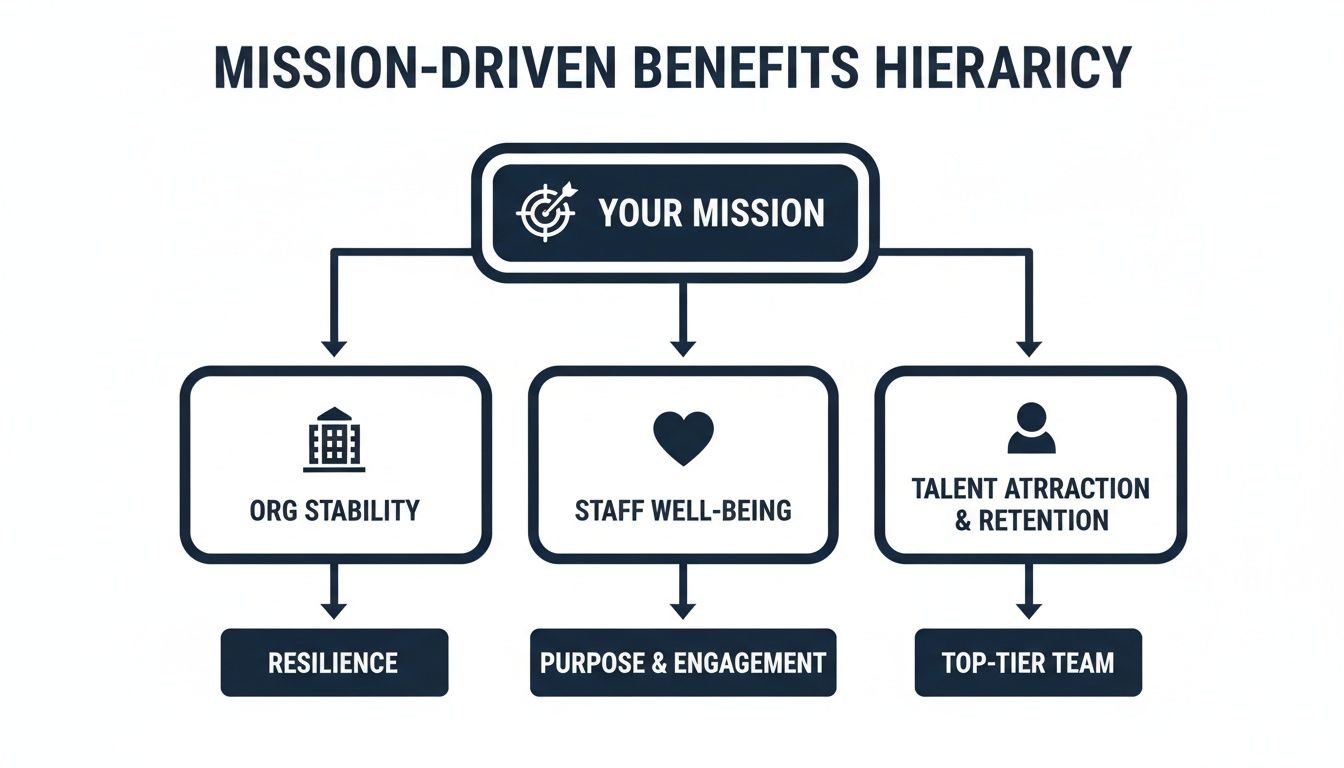
This visual makes it clear: a strong retirement plan is an investment in your people, which is an investment in your mission.
The 403(b) Plan: The Classic Choice
The 403(b) plan is the traditional go-to for tax-exempt organizations like public schools, hospitals, and charities. You can think of it as the nonprofit world’s version of the 401(k). It lets employees set aside pre-tax money from their paychecks, which then grows tax-deferred until they retire.
Because 403(b)s were literally built for this sector, they are often the default choice. Providers who specialize in serving nonprofits understand them inside and out. Some plans even offer unique perks, like special catch-up contribution rules for long-tenured employees—a feature you won’t typically find anywhere else.
The downside? The provider landscape can sometimes be tricky to navigate, especially for smaller organizations. Historically, the market was dominated by insurance companies whose products can be less flexible or carry higher costs than more modern alternatives.
The 401(k) Plan: A Flexible Alternative
Once seen as just for for-profit businesses, the 401(k) plan is now a popular and completely viable option for many nonprofits. Why the shift? Offering a 401(k) opens the door to a much broader and more competitive market of service providers. That competition can lead to lower administrative fees and more streamlined plan management.
For nonprofits looking for modern features and more design flexibility, adopting a 401(k) can be a good move. It allows an organization to build a plan that looks and feels a lot like what’s offered in the private sector, which can be a huge advantage when you're trying to attract top talent.
A 401(k) is no longer just for corporations. For a nonprofit, it can offer a competitive edge in benefits administration, cost, and design flexibility, making it a powerful tool for recruitment and retention.
457 Plans: The Supplemental Tool
Beyond the main 403(b) and 401(k) options, 457 plans serve a more specialized role. These are non-qualified, deferred compensation plans, typically offered to a select group of managers or highly compensated employees as an extra retirement benefit.
There are two main types you should know about:
457(b) Plans: These are available to governmental entities and certain tax-exempt organizations. They let eligible employees contribute up to a set annual limit, just like a 403(b) or 401(k). The best part? The contribution limits are separate. A key employee could max out their 403(b) and contribute the full amount to a 457(b).
457(f) Plans: These are even more flexible and can be offered to a select group of top-level executives. They allow contributions well above the standard limits but come with a catch: a "substantial risk of forfeiture." This means the money isn't guaranteed until the employee meets specific vesting requirements, like staying with the organization for a certain number of years.
These plans are powerful tools for attracting and keeping leadership talent, but they come with their own set of rules and compliance headaches. To make sure you’re making a fully informed decision, you can dive deeper into the selection process with our guide on how to choose the right retirement plan for your nonprofit.
At-A-Glance Comparison of Nonprofit Retirement Plans
To help you see the big picture, here’s a simple breakdown of the three primary plan types. It highlights who they’re for, what makes them unique, and where they fit best.
403(b) Plan:
Primary Audience: All employees of 501(c)(3) organizations, public schools, and hospitals.
Key Feature: The traditional nonprofit retirement plan, often with special catch-up rules.
Best For: Organizations seeking a well-established plan tailored to the tax-exempt sector.
401(k) Plan:
Primary Audience: All employees of any organization (nonprofit or for-profit).
Key Feature: Access to a broad provider market, often leading to lower fees and more design flexibility.
Best For: Nonprofits wanting to compete with private-sector benefits and access modern features.
457 Plan:
Primary Audience: A select group of management or highly compensated employees.
Key Feature: Allows for supplemental, deferred savings above 403(b)/401(k) limits.
Best For: Attracting and retaining key leadership talent with a competitive executive benefits package.
Ultimately, the right plan depends entirely on your organization’s size, budget, and strategic goals. This comparison should give you a solid starting point for the conversation.
Navigating Your Fiduciary and Compliance Duties
When your nonprofit offers a retirement plan, its leaders step into a critical legal role known as a fiduciary. Think of it as being a guardian for your employees' retirement savings. This isn't just a title—it's a serious legal commitment to act solely in the best interests of your plan participants and their beneficiaries.
This duty demands careful, documented decision-making every step of the way. It’s all about making sure the plan operates fairly, transparently, and exclusively for the benefit of your team. Getting this right builds trust and, just as importantly, protects your organization from very real legal and financial risks.

Understanding Your Core Fiduciary Responsibilities
Your fundamental duties as a fiduciary are built on two simple principles: loyalty and prudence. The Employee Retirement Income Security Act (ERISA), which governs most retirement plans, lays these obligations out clearly. Violating them can even lead to personal liability for any losses the plan suffers.
Here’s what that breaks down to in practice:
Acting with Prudence: You have to manage the plan with the care, skill, and diligence that a knowledgeable person would use in a similar situation. This isn't about guesswork; it's about making informed decisions based on solid research and documentation.
Ensuring Reasonable Fees: A huge part of being prudent is regularly checking your plan’s costs. You have an obligation to make sure all administrative and recordkeeping fees are reasonable for the services you’re getting.
Operating in Participants' Best Interests: Every single decision—from choosing a vendor to communicating a plan change—must be made with one goal in mind: benefiting your employees, not the organization.
These duties are the bedrock of responsible plan governance. They require you to build a structured process that proves you are always acting in a deliberate and thoughtful manner.
A fiduciary's role is not about being an expert, but about establishing and following a prudent process. Documenting your decisions, benchmarking your plan, and regularly reviewing your providers are the cornerstones of meeting this high standard of care.
Establishing a Prudent Process
To manage your fiduciary duties effectively, you can't just rely on informal chats or gut feelings. A formal, documented process is your best defense against compliance issues and a clear sign of good governance to your employees. This structure ensures your decisions are consistent, objective, and well-reasoned.
It all starts with creating a formal plan document. This is the legal rulebook for your retirement plan, outlining everything from who is eligible to how contributions work. Sticking to its terms is a non-negotiable fiduciary duty.
Next, you absolutely should form a retirement plan committee. This group, often made up of board members and key staff, should be officially tasked with overseeing the plan. The committee's job is to meet regularly, review plan performance, evaluate service providers, and document every decision in detailed meeting minutes. This creates a clear paper trail of prudent oversight.
The Importance of Regular Reviews
Your fiduciary responsibility doesn't end after you set the plan up. It's an ongoing job that demands continuous monitoring and periodic reviews. The retirement plan world changes, service providers evolve, and your own organization’s needs will shift over time.
A crucial piece of this is conducting regular reviews of your plan's service providers, including your recordkeeper and third-party administrator. Are their fees still competitive? Is their service quality meeting your employees' needs? Failing to benchmark your providers against the market can be seen as a breach of your duty to ensure fees are reasonable.
To steer clear of common pitfalls, it’s worth learning more about the top retirement plan mistakes nonprofits make and how to fix them. By building a consistent review cycle, you can confidently show that you are actively managing the plan for the good of your participants.
Evaluating Plan Costs and Selecting the Right Partner
Choosing the right administrative partner is just as critical as selecting the plan itself. A great retirement plan for a nonprofit depends on finding excellent service at a fair, transparent cost. Getting a handle on the fees involved isn't just a good idea—it's one of your core fiduciary duties and the key to building a sustainable partnership.
Think of it like inspecting a detailed invoice before you pay. You wouldn't accept a bill that just says "services rendered," and you shouldn't accept a retirement plan proposal that hides its fees in complicated jargon. Demanding total transparency is the only way to make a true apples-to-apples comparison.
Decoding Common Retirement Plan Fees
To properly weigh your options, you first have to understand what you're being charged for. Most plan costs fall into a few key buckets, each covering a different piece of the puzzle. Being able to spot these fees is the first step toward controlling them.
Here are the main costs you'll want to look for:
Recordkeeping Fees: This is the cost for the day-to-day administration of the plan. It covers things like tracking employee contributions, processing distributions, maintaining the plan website, and sending out participant statements.
Administration Fees: Sometimes bundled with recordkeeping, these fees cover the more technical side of plan management. This includes compliance testing, government filings (like the Form 5500), and making sure the plan document stays up to date.
Investment Fees: Every investment in the plan has its own expense ratio that the participant pays usually net of the overall return that that particular investment returns over time.
By insisting on a clear breakdown of these charges, you can sidestep surprises and make sure you aren’t overpaying for the basics.
Key Questions to Ask Every Potential Vendor
To dig deeper than the glossy marketing brochures, your retirement committee should have a list of critical questions ready for every potential partner. These questions go beyond the numbers to help you gauge the quality of service and see if the provider truly aligns with your mission.
Make sure you ask the following:
Can you provide a complete, all-inclusive fee schedule? Demand a line-item breakdown of every single charge, leaving no room for hidden costs.
How do you support nonprofit organizations specifically? Look for partners who get the unique challenges and culture of the nonprofit world.
What does your employee education program look like? A great partner will help your team understand and truly appreciate the benefit you’re offering them.
Who will be our dedicated point of contact? Consistent, personal service is vital, especially for smaller nonprofits that don't have large HR teams.
Ultimately, working with a new partner or keeping your existing partner is about more than just finding the lowest price; it's about finding the best value. The right provider will feel like an extension of your team, helping you fulfill your duties and empower your employees’ financial futures.
Boosting Employee Participation and Financial Wellness
You can have the best-designed retirement plan in the world, but it doesn't mean much if your employees aren't actually using it. After navigating all the complexities of choosing a plan and understanding your fiduciary duties, the real work begins: getting your team engaged. The goal is to shift your retirement plan from just another line item in the benefits handbook into a powerful tool that your staff actively uses to build their financial future.
This requires moving beyond a simple "here's your plan" email. It's about creating a true culture of financial wellness. When your people see and understand the value of what you're offering, they're far more likely to jump in, turning a great plan on paper into a great plan in practice.

From Awareness to Action Through Education
Good communication is the bridge between offering a benefit and watching your employees embrace it. Research from the 2025 NFP U.S. Retirement Trend Report shows a major confidence gap—only 33% of workers feel confident about retirement. But education makes all the difference. Among employees who truly understand their options, 76% are actively participating in their plans.
Here's the problem: nearly half (45%) don't even know their employer offers retirement planning resources. This points to a huge opportunity for nonprofits.
The mandate is clear: education drives participation. Your communication strategy needs to be ongoing, easy to understand, and built for the real-world needs of your team.
Proven Strategies to Increase Engagement
Getting people to sign up doesn't require a huge budget, but it does demand a thoughtful and consistent approach. The trick is to make complex financial ideas simple, relatable, and easy to act on.
Here are a few strategies that flat-out work:
Simplify Enrollment: Ditch the jargon. Create a clear, step-by-step enrollment guide that speaks in plain language. Focus on the immediate actions someone needs to take to get started. Checklists, visuals, and a good FAQ can make the whole process feel less overwhelming.
Highlight the Employer Match: If you offer a match, you need to shout it from the rooftops. Frame it for what it is: "free money." Use simple analogies to explain the immediate value. This is often the single biggest motivator to get people off the sidelines.
Show the Power of Compounding: People need to see it to believe it. Use simple charts or online calculators to show how even small, regular contributions can snowball into a significant nest egg over time. Explain that starting early, even with a little, gives their money more time to do the heavy lifting for them.
Host Educational Sessions: Offer regular workshops or webinars on basic financial topics—budgeting, debt, saving for goals. These sessions build financial confidence and prove you're invested in your employees' well-being. Just be sure to offer them at different times so everyone has a chance to attend.
A well-communicated retirement plan does more than just encourage savings. It sends a powerful message that your organization cares about its people's entire life journey, not just their time on the clock. That builds loyalty and strengthens your culture.
Making Education Stick
A one-and-done email isn't going to cut it. A successful engagement strategy uses multiple touchpoints throughout the year to reinforce key messages and keep the retirement plan top-of-mind. It can also be helpful to understand the most common missed opportunities with 403(b) plans to see where a little targeted education could make a huge difference.
By investing in your team’s financial literacy, you directly increase the value and impact of your retirement benefit. It’s an effort that helps secure your employees' futures while making your nonprofit a more attractive place to work for the passionate people driving your mission.
Your Actionable Checklist For Launching A Retirement Plan
Translating good intentions into a real, functioning retirement plan requires a clear roadmap. This final checklist pulls everything we've covered into a practical, step-by-step process. Think of it as your guide for moving from the initial idea to a successful and celebrated launch.
This process is designed specifically for nonprofit leaders, ensuring you can confidently establish a valuable benefit that strengthens your organization and supports your dedicated team. It provides a manageable framework to guide your board and leadership forward.
The urgency here is real. The nonprofit sector is facing a benefits crisis, with a recent survey of nonprofit finances revealing that only 54% of nonprofits offer retirement fund contributions. The gap is even more pronounced for smaller organizations, where only 10% of those with budgets under $250,000 provide this crucial benefit.
Phase 1: Foundational Steps
Before you even start looking at providers, the first phase is all about building internal agreement and defining what success looks like for your organization. This is where you lay the groundwork for a prudent, well-managed process.
Form a Retirement Plan Committee: Your first action is to assemble a dedicated team. This committee—often including board members, leadership, and HR staff—will be formally tasked with overseeing the entire process. Their primary responsibility is to fulfill the fiduciary duties of loyalty and prudence on behalf of your employees.
Define Your Goals and Objectives: Why are you starting this plan? The answer needs to be specific. Are you trying to reduce employee turnover, attract senior-level talent, or simply provide a foundational benefit that aligns with your values? Documenting clear objectives will guide every decision that follows.
Assess Your Budget and Capacity: Have an honest conversation about what your organization can actually afford. Determine if you can offer an employer contribution, like a match, and establish a clear budget for administrative fees. This financial clarity is essential before you begin evaluating potential partners.
A well-defined budget and clear objectives aren't just planning tools—they are evidence of a prudent fiduciary process. They demonstrate that your decisions are thoughtful, deliberate, and aligned with the best interests of your organization and your employees.
Phase 2: Selection and Design
With your foundation firmly in place, you can move on to the more technical aspects of choosing the right plan and the right partner. This phase is all about due diligence and making informed, side-by-side comparisons.
Select the Appropriate Plan Type: Using what you’ve learned, decide between a 403(b), a 401(k), or if a supplemental 457 plan makes sense. Your decision should flow directly from your goals, desired flexibility, and the provider landscape available to you.
Issue a Request for Proposal (RFP) and Select a Vendor: (only if it makes sense from a time/cost perspective) Create a formal RFP to get bids from multiple service providers. This is the only way to make a true apples-to-apples comparison of services and, most importantly, fees. Diligently vet each candidate to find a partner who truly understands the nonprofit world and offers transparent pricing or work with an expert to help get you through this stage of gathering information on the possible next (or existing) partner.
Phase 3: Implementation and Launch
This final phase is about bringing your plan to life. It involves finalizing the legal framework and—crucially—getting your employees excited and enrolled.
Draft and Adopt the Plan Documents: Work with your selected vendor and legal counsel to create the official plan document. This is the legal rulebook for your retirement plan, and your committee must formally vote to adopt it. This is the step that makes your plan official.
Create and Execute an Employee Communication Strategy: A retirement plan is only successful if people actually participate. Develop a clear, simple, and ongoing communication plan to educate your team. Focus on the value of saving, the power of an employer match (if you offer one), and the simple steps to get signed up. A strong launch sets the tone for long-term engagement and success.
Frequently Asked Questions
When it comes to retirement plans, a lot of the same questions come up for nonprofit leaders. Here are some direct, practical answers to help your team move forward with confidence.
What Is The Main Difference Between A 403(b) and A 401(k) For A Nonprofit?
The biggest difference is really in their history and the rules that govern them. The 403(b) was created specifically for tax-exempt organizations, so it’s often seen as the traditional, default choice for nonprofits. Its compliance rules are tailored to the sector. Remember, the single biggest advantage to a 403(b) is no required ADP (average deferral percentage testing) which allows the non-highly compensated individuals to max out their personal contribution to the plan.
A 401(k), on the other hand, is the plan most people know from the for-profit world, but plenty of nonprofits use them too. While they both give your employees the same core tax benefits, their underlying regulations can differ. ADP testing MUST be completed in a 401(k) which reduces what the highly compensated individuals can contribute year over year.
How Much Does It Cost To Start A Retirement Plan For A Small Nonprofit?
There’s a pretty wide range here. The final cost will depend on your provider, how complex the plan is, and how many employees you have. Generally, you can expect a one-time setup fee, ongoing annual fees for administration and recordkeeping, and sometimes a small fee for each person in the plan.
It’s absolutely critical to ask any potential partner for a clear, all-in fee schedule so there are no surprises down the road. The good news is that many modern providers have streamlined, low-cost options built specifically for the budgets of smaller nonprofits.
The true cost of a plan isn't just the sticker price. It's about finding the best value—a combination of reasonable fees, excellent service, and a partner who understands your mission and helps you fulfill your fiduciary duties.
Do We Need An Employer Match To Offer A Good Retirement Plan?
No, you don’t. An employer match is not a requirement to offer a valuable, meaningful retirement benefit. The plan's main job is to give your team a tax-advantaged way to save for their own future.
Of course, a match is a powerful tool for boosting participation and morale. But plenty of nonprofits successfully launch plans without one, especially when budgets are tight. You can always start by offering the plan itself and add a match later as your organization grows. The most important step is just getting started.
What Is The First Step Our Board Should Take To Explore A Plan?
The essential first move is to form a retirement plan committee or a small working group. This group, which should include board members and key staff, needs to be officially tasked with figuring out if a plan is feasible and what you want it to accomplish.
Their initial job is to:
Get a handle on the fundamental fiduciary duties involved.
Survey employees to see what they want and need.
Assess the organization's budget for setup and ongoing costs.
Start gathering information from potential consultants or providers.
Taking this structured approach creates accountability and a clear, documented process from day one. That protects both the organization and its leadership.
Ready to design a retirement plan that aligns with your mission and budget? Specialized guidance can help nonprofits navigate every step with confidence. Start the conversation today at npdiva.com.