

Stable Value vs Mone Market
- Stable value funds offer higher long-term yields than money market funds but require active oversight of wrap-provider risk. Money market funds provide daily liquidity and simpler management but have lower yields and different regulatory protections. Planning decisions should balance yield advantages against organizational capacity for monitoring and participant transfer restrictions.
For most retirement-plan sponsors whose priority is capital preservation with competitive long-term yield, a stable value fund is generally the stronger choice, provided your organization has the fiduciary bandwidth to monitor wrap-contract counterparty risk. If your plan needs immediate cash-like repricing, simpler vendor oversight, or you anticipate heavy short-term liquidity demands, a money market fund is the more appropriate fit.
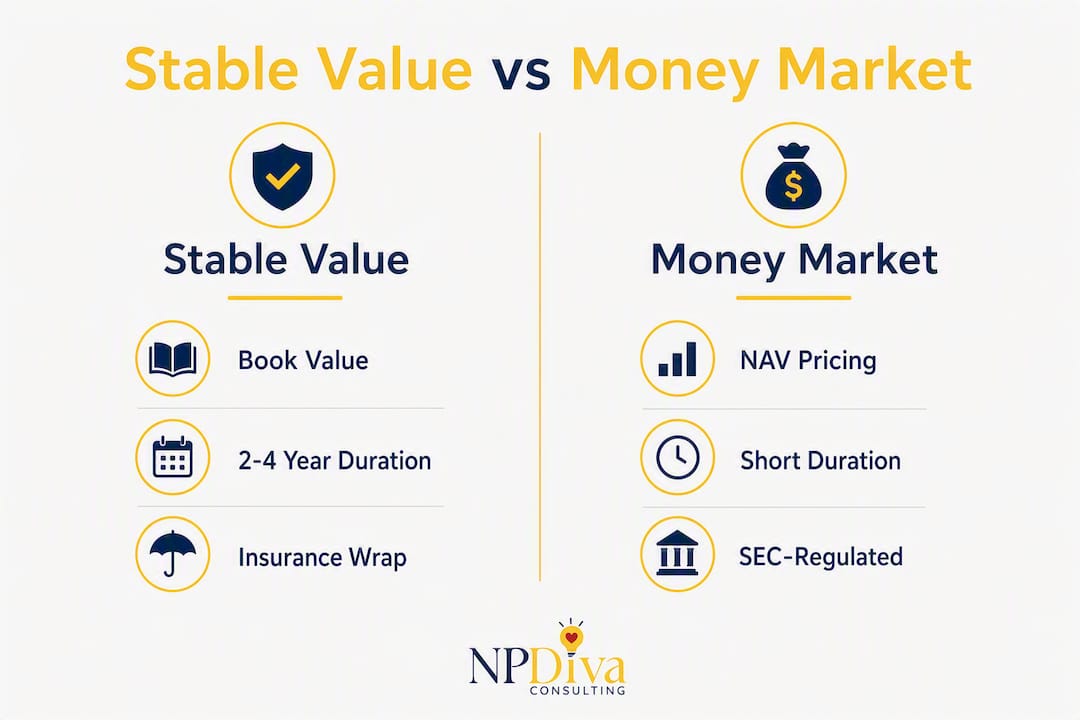
Both options serve a capital-preservation role, but they are structurally different products governed by different regulatory regimes. Stable value funds use wrap contracts (synthetic GICs or insurance agreements) to maintain book-value accounting and deliver benefit-responsive withdrawals. Money market funds are SEC-regulated mutual funds operating under Rule 2a-7, which sets liquidity, valuation, and reporting requirements. Neither is FDIC-insured, and neither carries a federal government guarantee. That distinction matters for every ERISA fiduciary communication you make to participants.
Key trade-offs at a glance:
- Yield advantage: Stable value funds have historically outperformed money market funds by roughly 1%–2% over a full market cycle, though past performance does not guarantee future results.
- Oversight burden: Stable value requires active monitoring of wrap-provider financial strength, MV/BV (market-to-book) ratios, and contract terms. Money market funds require less ongoing vendor management.
- Liquidity rules: Money market funds offer daily redemption with no transfer restrictions. Stable value funds typically impose equity-wash rules and competing-option transfer restrictions that protect the MV/BV ratio.
- Regulatory framework: Money market funds fall under SEC oversight; stable value wrap providers are governed by state insurance law and contract terms, with ERISA fiduciary duties applying to both.
Pro Tip: Before your next investment committee meeting, pull your stable value fund’s most recent MV/BV report and check whether the ratio has trended below 100% for more than two consecutive quarters. If it has, escalate your wrap-provider review to monthly.
How money market funds work inside a retirement plan
Money market funds are SEC-registered mutual funds that invest in ultra-short-term, high-quality debt instruments to preserve principal and provide daily liquidity. Under Rule 2a-7, funds must hold securities with remaining maturities under 397 days, maintain weighted average maturities of 60 days or less, and satisfy daily and weekly liquidity minimums. Typical holdings include U.S. Treasury bills, agency discount notes, commercial paper, repurchase agreements, and negotiable certificates of deposit.

That short-maturity profile is what drives repricing behavior. When the Federal Reserve raises or cuts rates, money market fund yields adjust within days or weeks rather than months, because the underlying securities roll over quickly. For plan sponsors, this means participants in a money market option see their credited yield track short-term market rates closely, which is an advantage in rising-rate environments and a disadvantage when rates fall.
Regulatory features sponsors should understand:
- Stable NAV vs. floating NAV: Government and retail money market funds generally maintain a $1.00 stable NAV. Institutional prime and municipal funds may use a floating NAV, which introduces modest mark-to-market variability.
- Liquidity gates and fees: Post-2023 SEC reforms removed mandatory liquidity gates and fees for most fund types, but sponsors should confirm the specific share class rules in their plan documents.
- No FDIC insurance: Money market funds are investment companies, not bank deposits. Participant balances are not insured by the FDIC or any federal agency.
Sponsor pros and cons:
- Pros: Daily liquidity with no transfer restrictions, lower vendor due-diligence burden, straightforward participant communications, rapid yield repricing.
- Cons: Lower long-term yield versus stable value over most full cycles, floating NAV risk for some institutional share classes, no book-value protection mechanism.
How stable value funds work inside a retirement plan
Stable value funds are retirement-plan-specific investment vehicles that use wrap contracts or insurance agreements to maintain book-value accounting, allowing participants to transact at book value rather than market value. They are not available in retail brokerage accounts; they exist exclusively within qualified retirement plans such as 401(k), 403(b) if applicable, and 457 plans.
Common legal structures:
- Collective investment trusts (CITs): Pooled vehicles maintained by a bank or trust company, available only to qualified plans. CITs offer transparency and typically lower fees than mutual fund wrappers.
- Synthetic GICs (wrap contracts): The fund holds a diversified bond portfolio, and a wrap provider (a bank or insurer) issues a contract promising to pay book value for benefit-responsive withdrawals. The wrap amortizes market-to-book gains and losses over the portfolio’s duration.
- Insurance general account GICs: The insurer holds assets on its general account and promises a credited rate. These offer less transparency because the sponsor cannot see the underlying portfolio.
- Separate account products: The insurer or manager holds assets in a dedicated account, providing more transparency than general account structures.
How the crediting-rate mechanism works:
The wrap contract permits book-value withdrawals by amortizing the difference between the portfolio’s market value and its book value over the remaining duration. The crediting rate is reset periodically (typically quarterly) using a formula that incorporates the portfolio’s yield, its duration, and the current MV/BV ratio. When market value falls below book value, the crediting rate is reduced to amortize the shortfall. When market value exceeds book value, the crediting rate rises.
Stable value portfolios typically carry a duration of roughly 2–4 years and invest primarily in U.S. Treasuries, agency securities, investment-grade corporates, and mortgage-backed securities. Non-investment-grade exposure is generally limited to small allocations, often 5% or less.
Key glossary terms:
| Term | Definition |
|---|---|
| CIT | Collective investment trust; a pooled vehicle for qualified plans only, maintained by a bank or trust company. |
| GIC | Guaranteed investment contract; an insurance product promising a fixed credited rate for a defined period. |
| Wrap contract | An agreement from a bank or insurer to pay book value for benefit-responsive withdrawals, covering the gap between market and book value. |
| MV/BV ratio | Market value divided by book value; a ratio below 1.00 signals the portfolio is underwater relative to participant account balances. |
| Crediting rate | The interest rate applied to participant balances, reset periodically based on portfolio yield, duration, and MV/BV. |
Sponsor pros and cons:
- Pros: Higher long-term yield than money markets over most cycles, book-value stability for participants, benefit-responsive withdrawal protection.
- Cons: Requires active monitoring of wrap-provider financial strength, contract terms, and MV/BV trends; transfer restrictions limit participant flexibility; general account structures reduce transparency.
How interest rates affect yields and valuations differently
The core difference in interest-rate sensitivity comes down to duration and amortization. Money market funds hold securities with maturities under 397 days, so their yields reprice to market rates within weeks. Stable value funds hold portfolios with durations of roughly 2–4 years, meaning rate changes flow through the crediting rate gradually as the amortization mechanism works through the portfolio.
What this means in practice:
- During rapid rate increases: Money market yields rise quickly, often outpacing stable value crediting rates for 12–24 months. Participants in stable value see a lag because the wrap is amortizing the market-value decline caused by rising rates.
- During rate declines: Stable value crediting rates hold up longer than money market yields because the portfolio still holds higher-yielding bonds purchased before rates fell. This is where stable value’s yield advantage tends to be most visible.
- In stable or slowly rising environments: Stable value typically maintains its yield edge because the longer-duration portfolio captures higher yields than ultra-short instruments.
Practical guidance for sponsors:
- If your investment committee expects a prolonged rate-rising cycle, acknowledge that money market yields may temporarily exceed stable value crediting rates. This is normal and does not indicate a problem with the stable value fund.
- If rates are expected to plateau or decline, stable value’s amortization lag works in participants’ favor.
- Monitor the MV/BV ratio during rate-rising periods. A ratio trending below 0.98 warrants closer review of the crediting-rate formula and wrap-provider capacity.
Principal risks and safeguards sponsors must understand
Neither product is risk-free. The risks differ in type and in the monitoring controls available to sponsors.
Money market fund risks:
- Credit risk: Exposure to commercial paper and bank paper means a default by an underlying issuer can affect NAV. Rule 2a-7 limits this through credit-quality requirements, but it does not eliminate it.
- Liquidity-concentration risk: Heavy redemptions during market stress can strain fund liquidity, as seen in March 2020 when short-term funding markets came under sharp stress amid the COVID-19 pandemic.
- Floating NAV risk: Institutional prime fund share classes may show NAV fluctuations, which can surprise participants expecting a stable $1.00 value.
Stable value risks:
- Wrap-provider credit risk: The book-value guarantee depends entirely on the claims-paying ability of the wrap issuer, not on a federal guarantee. If a wrap provider fails, participants may receive market value rather than book value.
- Event risk: Wrap contracts commonly include provisions that permit market-value settlements when employer-initiated actions materially change cash flows, such as mass terminations, plan freezes, or large asset transfers.
- MV/BV volatility: Rapid rate increases can push the MV/BV ratio below 1.00, reducing the crediting rate and, in extreme cases, limiting the wrap provider’s willingness to extend or renew contracts.
- General account opacity: Insurance general account products reduce disclosure, increasing single-credit risk tied to the insurer’s overall financial health.
Safeguards sponsors should require:
- Minimum financial-strength thresholds for wrap providers (e.g., investment-grade ratings from two major rating agencies, strong risk-based capital ratios).
- Clear put and termination provisions in the wrap agreement, specifying notice periods and settlement terms.
- Quarterly MV/BV reporting with a defined escalation threshold (e.g., action required if MV/BV falls below 0.97).
- Diversification across at least two wrap providers to reduce single-counterparty exposure.
- Annual cash-flow stress tests modeling mass-termination and large-lump-sum scenarios.
Pro Tip: Watch for these early warning signs of wrap-provider deterioration: a rating downgrade by Moody’s or S&P, a risk-based capital ratio trending below regulatory minimums, or an unusual mid-contract amendment to crediting-rate formula terms. Any one of these should trigger an immediate review.
Regulatory oversight and your fiduciary responsibilities
The two vehicles operate under fundamentally different regulatory regimes, and understanding that distinction shapes your monitoring obligations.
Money market funds under SEC Rule 2a-7:
Rule 2a-7 sets the legal framework for money market funds, covering portfolio quality, maturity limits, liquidity requirements, and NAV calculation methods. Sponsors selecting a money market fund for a retirement plan lineup are choosing a product with standardized, publicly disclosed regulatory requirements. Fund prospectuses and annual reports are publicly available, and the SEC’s reporting requirements mean sponsors can access consistent data for due diligence.
Stable value under contract and state insurance law:
Stable value wrap providers (banks and insurers) are regulated by state insurance departments or federal banking regulators, not the SEC. The wrap contract itself is a private agreement, and its terms vary by provider. CIT structures fall under bank regulatory oversight and OCC or state banking authority supervision. This means sponsors must conduct their own contract-level due diligence rather than relying on standardized public disclosures.
ERISA fiduciary duties for both options:
Under ERISA, plan sponsors owe a duty of prudence and loyalty when selecting and monitoring any plan investment option. For nonprofit boards managing fiduciary responsibilities, this means documenting the selection rationale, monitoring performance and risk on an ongoing basis, and retaining records sufficient to defend the process.
Monitoring checklist:
Numbered steps for ongoing compliance:
- Collect and review the current wrap agreement, including crediting-rate formula, put provisions, and event-risk definitions.
- Obtain quarterly MV/BV reports and track the ratio trend over at least eight quarters.
- Request annual credit reports or rating confirmations for each wrap provider.
- Review the crediting-rate reset history and confirm the formula has not changed without notice.
- Confirm redemption provisions and transfer restriction language in the plan document matches the wrap contract terms.
- Retain all procurement records, RFP responses, committee minutes, and annual risk memos for ERISA defense.
Comparing performance fairly: yield, duration, and fees
Sponsors comparing stable value and money market funds often make the mistake of comparing current crediting rates to current money market yields without accounting for the structural differences that drive those numbers.
The right comparison framework uses these dimensions:
| Dimension | Money Market Fund | Stable Value Fund |
|---|---|---|
| Primary objective | Capital preservation, daily liquidity | Capital preservation, competitive yield with book-value stability |
| Typical yield vs. money market | Tracks short-term rates closely | Historically 1%–2% higher over a full market cycle |
| Interest-rate sensitivity | High; reprices within days to weeks | Low to moderate; crediting rate lags by months |
| Liquidity and participant transactions | Daily redemption, no restrictions | Benefit-responsive; equity-wash and transfer restrictions apply |
| Credit/counterparty risk | Issuer-level credit risk; Rule 2a-7 limits exposure | Wrap-provider credit risk; not federally guaranteed |
| Regulatory oversight | SEC Rule 2a-7 | State insurance law, banking regulation, contract law |
| Fees and operational complexity | Lower; standardized fund expenses | Higher; wrap fees, investment management fees, potential CIT admin costs |
| Suitability | Plans needing simplicity, rapid repricing, or high near-term liquidity | Plans prioritizing long-term yield, book-value stability, and participant retention |
Methodology pitfalls to avoid:
- Do not compare book-value returns for stable value against market-value returns for money market funds. Use net crediting rates for stable value and net yields for money market funds, both after fees.
- Peer-group selection matters. Use stable value peer groups from sources such as the Stable Value Investment Association or NAGDCA benchmarking reports, not broad fixed-income categories.
- Survivorship bias affects long-term return comparisons. Funds that closed during stress periods are often excluded from historical averages, making the category look more stable than it was.
When requesting data from managers, ask for: net crediting rate history (at least 10 years), MV/BV ratio history, wrap-fee disclosure, portfolio duration history, and wrap-provider concentration by percentage of assets covered.
How participant transactions and transfer restrictions work
Daily operations differ significantly between the two options, and those differences affect both participant experience and plan administration.
Money market funds process participant transactions at the fund’s NAV, typically the same business day or next business day. There are no transfer restrictions, no competing-option rules, and no equity-wash requirements. A participant can move from a money market fund to an equity fund and back without any waiting period.
Stable value funds operate under benefit-responsive withdrawal rules. Participants can withdraw for qualifying plan events (retirement, termination, hardship, loans, required minimum distributions) at book value. However, transfers to competing options (money market funds, short-term bond funds, or other cash-equivalent options) are typically subject to equity-wash rules: a participant must first move to a non-competing option for 90 days before transferring to a competing option.
Scenarios that create operational complexity:
- Mass layoffs or reductions in force: A large wave of terminations triggers benefit-responsive withdrawals at book value, which is normal. However, if the plan sponsor initiates a plan freeze or partial termination, wrap contracts may require market-value settlement rather than book value, potentially exposing participants to principal loss.
- Large lump-sum distributions: A single very large distribution (e.g., a departing executive with a large balance) can strain the MV/BV ratio if the fund is already underwater.
- Plan mergers or asset transfers: Moving stable value assets to a successor plan or a new recordkeeper can trigger put provisions requiring advance notice of 12 months or more.
Operational guidance for plan administrators:
- Communicate equity-wash rules clearly in participant enrollment materials and annual disclosures.
- Maintain a liquidity ready-list: a quarterly estimate of expected benefit-responsive withdrawals for the next 12 months.
- Notify your wrap provider in writing before any plan-level event that could qualify as an employer-initiated action under the contract.
- Coordinate with your recordkeeper to confirm that transfer restriction logic is coded correctly in the system before any fund lineup change goes live.
Your fiduciary playbook for selecting and monitoring these options
Selecting either option is a fiduciary act under ERISA. The process you follow matters as much as the outcome, and documentation is your primary defense.
Selection checklist:
- Confirm the investment objective aligns with your plan’s capital-preservation goal and participant demographics.
- For stable value: verify wrap-provider credit strength (minimum investment-grade ratings from two agencies), review contract termination and put provisions, and request at least eight quarters of MV/BV history.
- For money market: confirm share class (government vs. prime vs. municipal), NAV type (stable vs. floating), and expense ratio.
- Review portfolio guidelines: for stable value, confirm duration limits, credit-quality minimums, and non-investment-grade caps.
- Assess fees and total cost, including wrap fees for stable value and fund expense ratios for both.
- Evaluate transparency: CIT and dedicated separate-account stable value structures provide more disclosure than general account products.
Monitoring timeline:
Industry best practices recommend an annual deep-dive review under normal conditions, a quarterly dashboard covering MV/BV trends, crediting-rate resets, and wrap-provider ratings, and escalation to monthly monitoring during market stress or plan-level events.
Red flags requiring immediate action:
- MV/BV ratio trending below 0.97 for two or more consecutive quarters.
- A wrap-provider rating downgrade to below investment grade.
- An abrupt, unexplained change to the crediting-rate formula.
- Limited or delayed disclosure from a general account structure.
- Wrap-provider risk-based capital ratio declining toward regulatory minimums.
Documentation to maintain for ERISA defense:
- RFP and vendor-selection records, including scoring criteria and committee votes.
- Annual risk memos summarizing MV/BV trends, wrap-provider health, and any contract amendments.
- Investment committee minutes documenting every review and any decision to retain or replace the option.
- Ongoing quarterly dashboards retained for at least six years.
Which option fits your plan’s goals and sponsor capacity?
The decision between stable value and money market is not purely about yield. It is about matching the product’s risk profile and operational demands to your organization’s capacity and your participants’ needs.
Decision matrix:
- Small nonprofit with limited fiduciary bandwidth: A money market fund is often the more defensible choice. The standardized Rule 2a-7 framework reduces vendor due-diligence complexity, and the absence of wrap-contract monitoring requirements lowers the ongoing governance burden. For nonprofits choosing retirement plan options with lean HR teams, that simplicity has real governance value.
- Mid-size to large plan with stable headcount and long-term focus: Stable value is typically the stronger fit. The 1%–2% historical yield advantage compounds meaningfully over decades for participants in accumulation, and the book-value stability reduces participant anxiety during market downturns.
- Plans anticipating heavy short-term liquidity needs: If your organization expects significant workforce reductions, a pending merger, or a plan freeze within the next 24 months, a money market fund avoids the event-risk provisions that could force market-value settlements in a stable value contract.
- Plans offering both options: Some sponsors include both, positioning the money market fund as the short-term parking option and stable value as the conservative long-term holding. This requires clear participant communication to prevent confusion about transfer restrictions.
When to offer both:
- Your participant base includes both near-retirees (who benefit from stable value’s yield) and employees who frequently rebalance (who need money market’s unrestricted liquidity).
- Your plan is large enough to absorb the additional vendor oversight without straining your governance calendar.
Pro Tip: When evaluating vendor proposals, require written answers to these four questions: (1) What is the current MV/BV ratio and its 12-quarter trend? (2) Who are the wrap providers and what are their current ratings? (3) What events trigger a market-value settlement? (4) What is the equity-wash rule and how is it enforced in the recordkeeping system? A vendor that cannot answer all four clearly is not ready for your plan.
NPDiva Consulting’s perspective on the nonprofit sponsor decision
Nonprofit plan sponsors face a version of this decision that is meaningfully different from the corporate context. Staffing constraints, budget limits, and mission-driven workforce patterns all shape which option is actually manageable for your organization.
Nonprofit-specific checks before deciding:
- Asset threshold for dedicated separate-account stable value: Most dedicated separate-account products require plan assets of $50 million or more. Smaller nonprofits are typically limited to pooled CIT or general account products, which carry different transparency and monitoring requirements.
- Participant liquidity behavior: Mission-driven organizations often see higher staff turnover in program roles and longer tenure in leadership roles. Model your expected benefit-responsive withdrawal rate against the stable value fund’s MV/BV ratio before committing.
- Vendor oversight capacity: If your HR team handles retirement plan administration alongside other responsibilities, the additional monitoring burden of a stable value fund is a real governance cost. Be honest about whether your committee can sustain quarterly dashboards and annual deep dives.
How NPDiva Consulting helps nonprofit sponsors navigate this decision:
NPDiva Consulting can help you assess options, clarify fiduciary process, and build an approach that fits your staff, budget, and administrative capacity without unnecessary complexity.
Pro Tip: For small nonprofits with plans under $10 million, a low-cost monitoring cadence works well: a 30-minute quarterly dashboard review using the fund’s MV/BV report and a single-page crediting-rate summary, with a full annual review documented in committee minutes. This approach satisfies ERISA’s prudence standard without requiring a dedicated investment staff member.
Key Takeaways
For most nonprofit plan sponsors, stable value funds offer a better long-term yield than money market funds, but that advantage requires active wrap-contract monitoring and clear participant communication about transfer restrictions.
| Point | Details |
|---|---|
| Yield advantage of stable value | Stable value has historically outperformed money market funds by roughly 1%–2% over a full market cycle. |
| Neither option is FDIC-insured | Both carry credit and counterparty risk that sponsors must disclose and monitor under ERISA. |
| Wrap-contract oversight is non-negotiable | Sponsors must track MV/BV ratios, wrap-provider ratings, and contract terms on at least a quarterly basis. |
| Match the option to your capacity | Small nonprofits with limited governance bandwidth often find money market funds more defensible; larger plans benefit from stable value’s yield. |
| NPDiva Consulting supports the full process | NPDiva provides vendor evaluation, fiduciary documentation, and participant communications tailored to nonprofit plan sponsors. |
The case for treating this as a governance decision, not just an investment decision
Most plan sponsors frame the stable value vs. money market question as a yield comparison. That framing misses the more important issue: which option can your organization actually govern well?
A stable value fund that delivers a 1%–2% yield advantage but receives only cursory annual reviews is a fiduciary liability, not an asset. Wrap contracts contain provisions that can shift principal risk to participants under employer-initiated events, and those provisions are only protective when sponsors understand them and plan around them. A money market fund with lower yield but clean, documented oversight is often the more defensible choice for a nonprofit with a lean governance structure.
The sponsors who get this right are not necessarily the ones who chose the higher-yielding option. They are the ones who matched the product’s oversight demands to their organization’s actual capacity, documented their process thoroughly, and reviewed their choice at least annually. That discipline, applied consistently, is what ERISA’s prudence standard actually requires.
Useful sources for plan sponsors
Authoritative references for further reading and due diligence:
- SEC Rule 2a-7 Final Rule (2023): The governing regulation for money market funds, covering liquidity requirements, NAV calculation, and reporting obligations. Use this to understand sponsor disclosure expectations and share-class differences.
- NAGDCA: Evaluating a Stable Value Investment Option, Part I: Covers wrap-provider financial strength monitoring, claims-paying ability, and fiduciary evaluation criteria. The primary reference for sponsor due-diligence checklists.
- NAGDCA: Evaluating a Stable Value Investment Option, Part II: Addresses portfolio composition, credit-quality guidelines, and transparency considerations for CIT vs. general account structures.
- SPARK Institute: Stable Value White Paper: Comprehensive treatment of wrap mechanics, crediting-rate formulas, duration, and fiduciary monitoring cadence. The most detailed operational reference available.
- Stable Value Investment Association: Basics and FAQs: Plain-language explanations of wrap contracts, event-risk provisions, and benefit-responsive withdrawal mechanics. Useful for participant communication drafting.
- Minnesota Retirement Systems: Stable Value vs. Money Market Comparison: A state retirement office comparison that illustrates the historical yield differential and structural differences. A useful benchmark for sponsors requesting similar analysis from their own managers.
- President’s Working Group on Financial Markets: Money Market Fund Report: Documents the March 2020 stress event in short-term funding markets and the policy response. Relevant for sponsors assessing money market liquidity risk under stress conditions.
FAQ
Is stable value the same as a money market fund?
No. Stable value funds use wrap contracts to maintain book-value accounting and typically hold portfolios with durations of 2–4 years, while money market funds are SEC-regulated under Rule 2a-7 and hold securities with maturities under 397 days. They serve similar capital-preservation goals but operate under different structures, regulatory regimes, and risk profiles.
Should a plan sponsor move retirement assets to a stable value fund?
It depends on the plan’s governance capacity and participant needs. Stable value funds have historically delivered roughly 1%–2% higher yields over a full market cycle than money market funds, but they require active monitoring of wrap-provider financial strength, MV/BV ratios, and contract terms. Sponsors with limited oversight bandwidth may find a money market fund more defensible.
What are the main risks of money market funds in a retirement plan?
The primary risks are credit exposure to underlying issuers (commercial paper, bank paper), liquidity-concentration risk during market stress, and floating NAV variability for institutional prime share classes. Money market funds are not FDIC-insured, and their yields fall quickly when short-term rates decline.
How does the equity-wash rule affect participants in a stable value fund?
The equity-wash rule requires participants to transfer their stable value balance to a non-competing fund (such as an equity or bond fund) and hold it there for 90 days before moving to a competing option like a money market fund. This restriction protects the fund’s MV/BV ratio by preventing arbitrage between book-value and market-value pricing.
How much can a stable value fund earn compared to a money market fund?
Stable value funds have historically outperformed money market funds by roughly 1%–2% over a full market cycle, according to state retirement system comparisons. That gap narrows or reverses temporarily during rapid rate-rising periods when money market yields reprice faster than stable value crediting rates can adjust.
This article provides general educational information for plan sponsors and does not constitute legal, tax, or investment advice. Sponsors should consult qualified ERISA counsel and a registered investment advisor before making plan investment decisions.